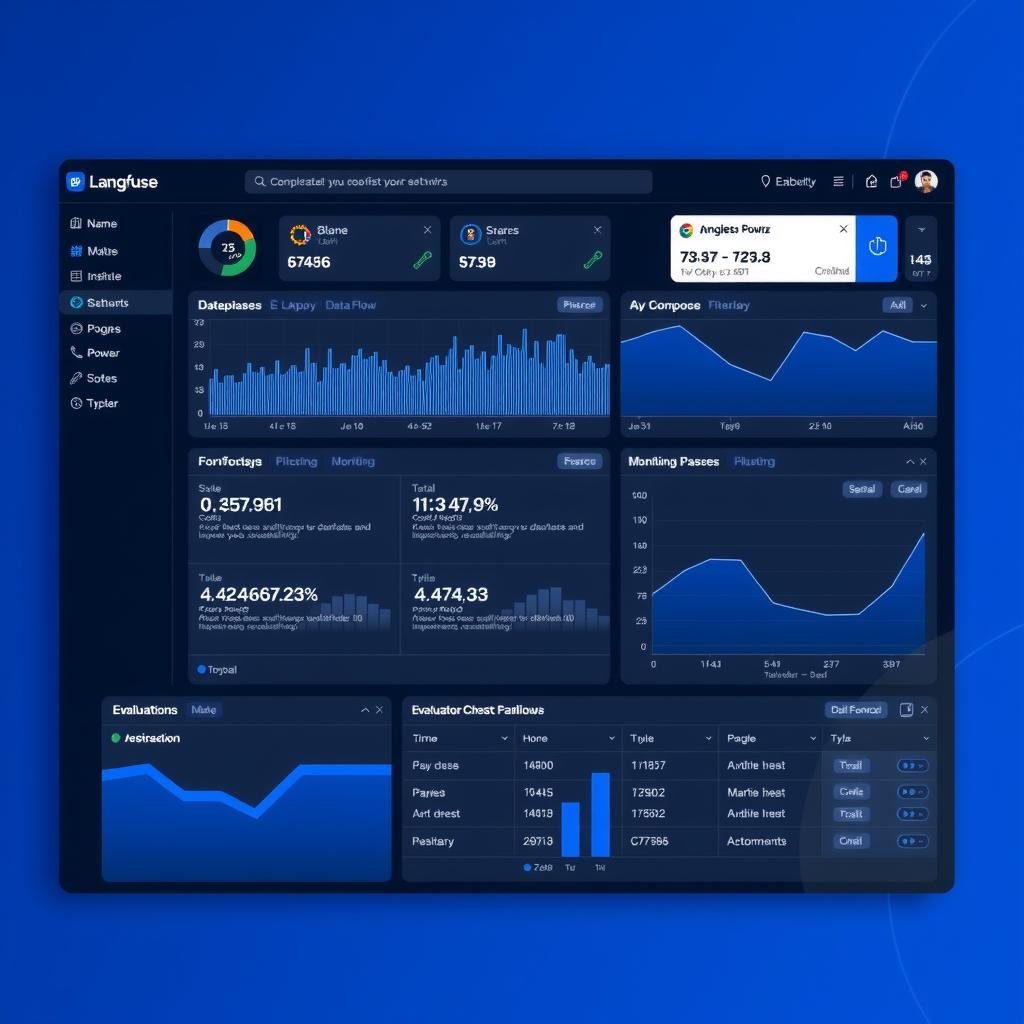
Langfuse Review 2026 — Open-Source LLM Observability & Evaluation Platform
📖 What Is Langfuse Review 2026?
Langfuse is an open-source LLM engineering platform that combines observability (tracing), evaluation, prompt management, and experiments into a single integrated workflow. Think of it as the open-source answer to the question: "How do I know my LLM application is working correctly in production?"
Founded in 2023, Langfuse has grown to serve 19 of the Fortune 50, processing 10+ billion observations per month across 2,300+ customers [1]. It has 23,000+ GitHub stars and 5,000+ Discord community members [7]. The platform is built on OpenTelemetry — meaning it works with any language (Python, TypeScript, Go, Java, .NET, Ruby, PHP, Swift) and any framework (LangChain, CrewAI, Pydantic AI, Vercel AI SDK, and 80+ other integrations) [2].
What sets Langfuse apart from competitors is the MIT license on all product features [7]. There is no feature-gated enterprise edition — every capability (tracing, evaluation, prompt management, playground, experiments, human annotation) is available in the free self-hosted version. This has made it the default choice for teams that want full data ownership and unlimited team members without per-seat pricing.
The platform architecture uses ClickHouse OLAP for fast analytical queries, Redis queue for async ingestion, and S3/Blob storage for large payloads — enabling 99.9% uptime and sub-second trace queries even at billion-event scale [1]. SOC 2 Type II, ISO 27001, GDPR compliance, and HIPAA eligibility make it enterprise-ready out of the box [1].
📊 At a Glance & ✅ Pros & Cons
| Feature | Langfuse | Braintrust | LangSmith |
|---|---|---|---|
| Category | AI Evaluation | AI Evaluation | AI Evaluation |
| Pricing | Free - $2,499/mo [6] | Free - $249/mo | Free - $39/seat/mo |
| Open Source | ✅ Full MIT | ✅ Yes | ❌ No |
| Self-Hostable | ✅ Full (MIT) | ⚠️ Enterprise only | ❌ No |
| OpenTelemetry | ✅ Full native | ⚠️ Partial | ⚠️ Partial |
| Tracing | ✅ Yes | ✅ Yes | ✅ Yes |
| Eval CI/CD Gates | ✅ Via SDK | ✅ Native best | ⚠️ Manual |
| Prompt Management | ✅ Yes | ✅ Yes | ✅ Yes |
✅ What It Does Best
- Full MIT open source — all product features MIT-licensed; self-host via Docker Compose or Kubernetes. No feature-gated enterprise edition.
- Unified observability + eval platform — tracing, evaluation, prompt management, playground, and experiments in a single integrated workflow. No duct-taping tools together.
- Billion-scale performance — ClickHouse OLAP database, async ingestion via Redis, S3/Blob storage. Handles 10+ billion observations/month for 19 of Fortune 50.
- Full OpenTelemetry native — works with any language and any framework. 80+ integrations out of the box including LangChain, CrewAI, Pydantic AI, and Vercel AI SDK.
- Generous free tier — 50k observations/month free with unlimited team members. Core plan at $29/mo includes 100k observations [6].
- Agent-native tooling — SKILL.md for AI coding agents, CLI for CI/CD, Platform MCP Server for IDE integration.
❌ Where It Falls Short
- Self-hosting complexity — production-grade self-hosting requires Docker Compose with Postgres, ClickHouse, Redis, and S3-compatible storage. Not a one-command deploy.
- Eval depth lags Braintrust — trace-to-test pipeline and CI/CD eval blocking are more mature in Braintrust. Langfuse's eval runs are newer.
- No runtime guardrails — evaluates after the fact; can't block unsafe LLM outputs before reaching users.
- SDK learning curve — teams new to observability infrastructure need time to instrument their full stack properly.
- Dashboard customization lags enterprise APM — less flexible than Datadog or Grafana for advanced analytics.
Evaluation-first AI observability with trace-to-test CI/CD pipeline. Stronger eval workflow but cloud-only and more expensive at scale.
LangChain-native observability with zero-config tracing. Per-seat pricing and vendor lock-in. No self-hosting option available.
Enterprise ML observability platform with strong drift monitoring and fairness evaluation. Better for ML teams than LLM-focused app builders.
Lightweight LLM observability focused on cost tracking and API monitoring. Less eval depth than Langfuse but simpler to set up.
✨ Capabilities & Agentic Deep Dive
Hierarchical Tracing
Langfuse captures every LLM call, tool invocation, retrieval step, and agent loop in hierarchical traces. Each trace is structured as a tree of spans — parent spans represent high-level operations (e.g., "answer user question") while child spans capture individual steps (e.g., "retrieve documents", "call OpenAI", "rerank results"). You can filter by user, session, cost, latency, or custom metadata. This granularity means debugging a multi-agent system becomes a matter of clicking through trace trees rather than grepping log files [3].
LLM-as-a-Judge Evaluation
Langfuse's evaluation system lets you run automated scoring on production traces. LLM-as-a-judge uses a configurable judge model to evaluate outputs against custom criteria (correctness, conciseness, helpfulness, safety). Code evaluators run deterministic checks (regex, JSON schema validation, length constraints). Human annotation queues route traces to domain experts for manual review. All evaluation methods share the same scoring infrastructure — scores flow into the same dashboards and analytics regardless of source [4].
Prompt Management with Versioning
Separate prompts from code with Langfuse's prompt management system. Prompts are versioned, deployable with one click, and rollback-capable. Each version is cached at the edge for low-latency fetching in production. The playground lets you test prompt changes on real production inputs before deploying — select a production trace, tweak the prompt, and see how the output changes without running the full pipeline [5].
Experiments and Datasets
Langfuse supports systematic A/B testing of prompt variants, model choices, and code changes. Define test cases as datasets (curated from production failures or hand-crafted edge cases), run experiments comparing different configurations side by side, and see which variant scores higher across your evaluation metrics. CI/CD integration means experiments can run automatically on every PR, catching regressions before they ship [6].
Agent-Native Tooling
Langfuse ships a SKILL.md file that allows AI coding agents (Claude Code, Cursor, Codex) to manage traces, evals, and prompts via natural language. The CLI provides full API access for scripting workflows in CI/CD. The Platform MCP Server lets agents interact with Langfuse data programmatically from the IDE. This means you can ask your coding agent to "set up tracing for my RAG pipeline with Langfuse" and it handles the instrumentation — a unique differentiator for the AI engineering workflow [1].
🔬 AI Performance Analysis
🦾 Ease of Use
Langfuse's SDK integration is straightforward for anyone familiar with decorators and API keys. The @observe() decorator in Python auto-traces function calls with minimal boilerplate — three lines of setup code gets you production tracing [2]. The platform UI is clean and intuitive: trace trees are visual, dashboards are pre-configured, and the playground runs prompts against live production data. However, the full power of Langfuse requires understanding observability concepts (spans, traces, scoring, datasets) and setting up integrations for each framework you use. Self-hosting adds significant complexity — Docker Compose with three backing services is not trivial. For teams new to LLM observability, expect a few hours of setup before everything clicks.
⚙️ Features
Langfuse has the broadest feature set in the AI evaluation category. Tracing with hierarchical spans, LLM-as-a-judge evaluation, code-based evaluators, human annotation queues, prompt management with versioning and edge caching, playground for prompt testing on real data, experiments with A/B comparison, datasets for test case management, CI/CD integration, cost and latency monitoring, and custom dashboards. The platform supports 80+ integrations spanning all major agent frameworks, model providers, and languages. The only notable gap is the absence of a built-in trace-to-test pipeline like Braintrust's — converting a production trace into a test case requires manual dataset creation rather than a one-click operation. For most teams, however, the feature breadth outweighs this gap.
🚀 Performance
Langfuse is built for scale. The ClickHouse OLAP database handles analytical queries on billions of traces in milliseconds. Async ingestion via Redis queue ensures the instrumentation never blocks your production application. S3/Blob storage keeps large payloads (full prompt/response text) out of the hot database. The result is 99.9% uptime with consistent sub-second trace queries even at 10+ billion observations per month [1]. Ingestion throughput scales from 1,000 req/min on the free Hobby plan to custom limits on Enterprise. The only performance caveat is self-hosted deployments — running ClickHouse at scale requires careful configuration (sharding, replication, compaction) that smaller teams may not have the operational expertise to manage.
📚 Documentation
Langfuse's documentation is excellent — clear, comprehensive, and well-organized. The evaluation docs include a task-to-feature mapping table that tells you exactly which feature to use for each evaluation goal (e.g., "want to review traces manually → Annotation Queues", "want to block deploys on regressions → CI/CD experiments") [4]. The SDK reference is thorough with code examples in Python and TypeScript. Integration guides cover 80+ tools with step-by-step setup instructions. Video walkthroughs guide users through tracing, evaluation, and prompt management. The docs are consistently updated — changelogs and migration guides are transparent about breaking changes. The only miss is that advanced self-hosting configuration (ClickHouse tuning, Kubernetes scaling) could benefit from more depth.
🎯 Support
Langfuse has built an active community: 23,000+ GitHub stars, 5,000+ Discord members, and 2,300+ customers [7]. GitHub issues are responsive — most get replies within 24 hours. The Discord community is helpful for setup questions and best practices. In-app support starts on the Core plan ($29/mo) with a 48-hour SLO. Pro ($199/mo) provides prioritized support. Enterprise ($2,499/mo) includes a dedicated engineer with custom SLA and SL0. The startup discount (50% off first year) and open-source project credits ($300/mo) make paid plans accessible to small teams [6]. The self-hosted version relies primarily on community support, which is active but not guaranteed — a consideration for mission-critical deployments.
🎯 Ideal Use Cases
✅ Best For
|
❌ Not Ideal For
|
Free Hobby tier: 50k observations/month, 30-day retention, 2 users — no credit card required. Core: $29/mo (100k obs, unlimited users, 90-day retention). Pro: $199/mo (100k obs, 3-year retention). Enterprise: $2,499/mo (dedicated engineer, SLA). Self-hosting is free and fully MIT-licensed. Volume discounts available: $8/100k additional units, dropping to $6/100k at 50M+ [6].
Quick start: Sign up at langfuse.com → install the SDK → add @observe() decorator to your LLM functions → start tracing in minutes. Or self-host via Docker Compose from the GitHub repo.
| ❓ FAQ | |
|---|---|
| What is Langfuse used for? | Langfuse is an open-source LLM engineering platform used for observability (tracing every LLM call, tool invocation, and retrieval step), evaluation (LLM-as-a-judge, code evaluators, human annotation), prompt management (versioned, one-click deploy and rollback), and experiments (A/B test prompts, models, and code variants). |
| Is Langfuse free? | Yes. The self-hosted version is fully MIT-licensed and completely free. The cloud Hobby plan gives 50k observations/month free. Paid plans start at $29/month for Core [6]. |
| Can I self-host Langfuse? | Yes — Langfuse is open source under the MIT license. Self-host via Docker Compose (Postgres, ClickHouse, Redis) or Kubernetes (Helm). AWS, GCP, and Azure Terraform templates are available. |
| How does Langfuse compare to Braintrust? | Langfuse is stronger for open-source/self-hosted teams with broader framework support and full OpenTelemetry. Braintrust has a more mature trace-to-test pipeline and CI/CD eval blocking. |
| How does Langfuse compare to LangSmith? | LangSmith has zero-config tracing if your entire stack is LangChain/LangGraph. Langfuse supports any framework via OpenTelemetry, is fully open source, and doesn't have per-seat pricing. LangSmith is better for pure LangChain shops; Langfuse is better for heterogeneous stacks. |
| What integrations does Langfuse support? | 80+ integrations including LangChain, CrewAI, Pydantic AI, Vercel AI SDK, OpenAI Agents SDK, Claude Code, LiteLLM, OpenClaw, AutoGen, LlamaIndex, DSPy, Cursor, n8n, Dify, OpenWebUI, and more. |
| Does Langfuse support multi-modal? | Yes. Multi-modal support is available in free beta on all plans, including image inputs for vision-based evaluations. |
| 📖 Related Reads | |
|---|---|
| Braintrust Review 2026 | Evaluation-first AI observability with trace-to-test CI/CD pipeline. The strongest commercial alternative to Langfuse. |
| LangGraph Review 2026 | Multi-agent orchestration framework from LangChain. Pair with Langfuse for production observability. |
| CrewAI Review 2026 | Multi-agent orchestration framework. Langfuse integrates with CrewAI for full trace visibility. |
| OpenAI Agents SDK Review 2026 | OpenAI's agent framework with built-in tracing. Langfuse provides deeper evaluation for production deployments. |
| 📚 Verification & Citations | |
|---|---|
| https://langfuse.com | Langfuse Official Website — product features, pricing, and platform overview. Accessed June 2026. |
| https://langfuse.com/docs | Langfuse Documentation — setup guide, SDK reference, and evaluation overview. Accessed June 2026. |
| https://langfuse.com/docs/evaluation/overview | Langfuse Evaluation Docs — task-to-feature mapping table and evaluation methods. Accessed June 2026. |
| https://langfuse.com/docs/prompts | Langfuse Prompt Management Docs — versioning, deployment, and edge caching. Accessed June 2026. |
| https://langfuse.com/docs/experiments | Langfuse Experiments Docs — datasets, A/B comparisons, and CI/CD integration. Accessed June 2026. |
| https://langfuse.com/pricing | Langfuse Pricing Page — plan tiers, volume discounts, and features. Accessed June 2026. |
| https://github.com/langfuse/langfuse | Langfuse GitHub Repository — 23K+ stars, MIT license, source code. Accessed June 2026. |
Langfuse released SKILL.md for AI coding agents, CLI for CI/CD integration, and Platform MCP Server for IDE-based interaction. Now agents can manage traces, evals, and prompts via natural language commands.
Processing 10+ billion observations per month across 2,300+ customers. 19 of Fortune 50 organizations now use Langfuse for LLM observability and evaluation.
Langfuse launched multi-modal support in free beta, enabling vision-based evaluations for image inputs across all pricing plans.
- June 12, 2026: Initial published review — full v4 canonical structure with performance analysis, alt-grid, verdict banner, and competitive comparison.
📖 Related Reads
- NiteAgent — AI agent development, frameworks, and production patterns
- ToolBrain — tool reviews, LLM comparisons, and AI workflow guides
- Hermes Tutorials — Hermes Agent setup, configuration, and advanced workflows
- NoCode Insider — AI workflow automation with no-code tools, agents, and APIs
Cross-links automatically generated from None.
Back to all posts