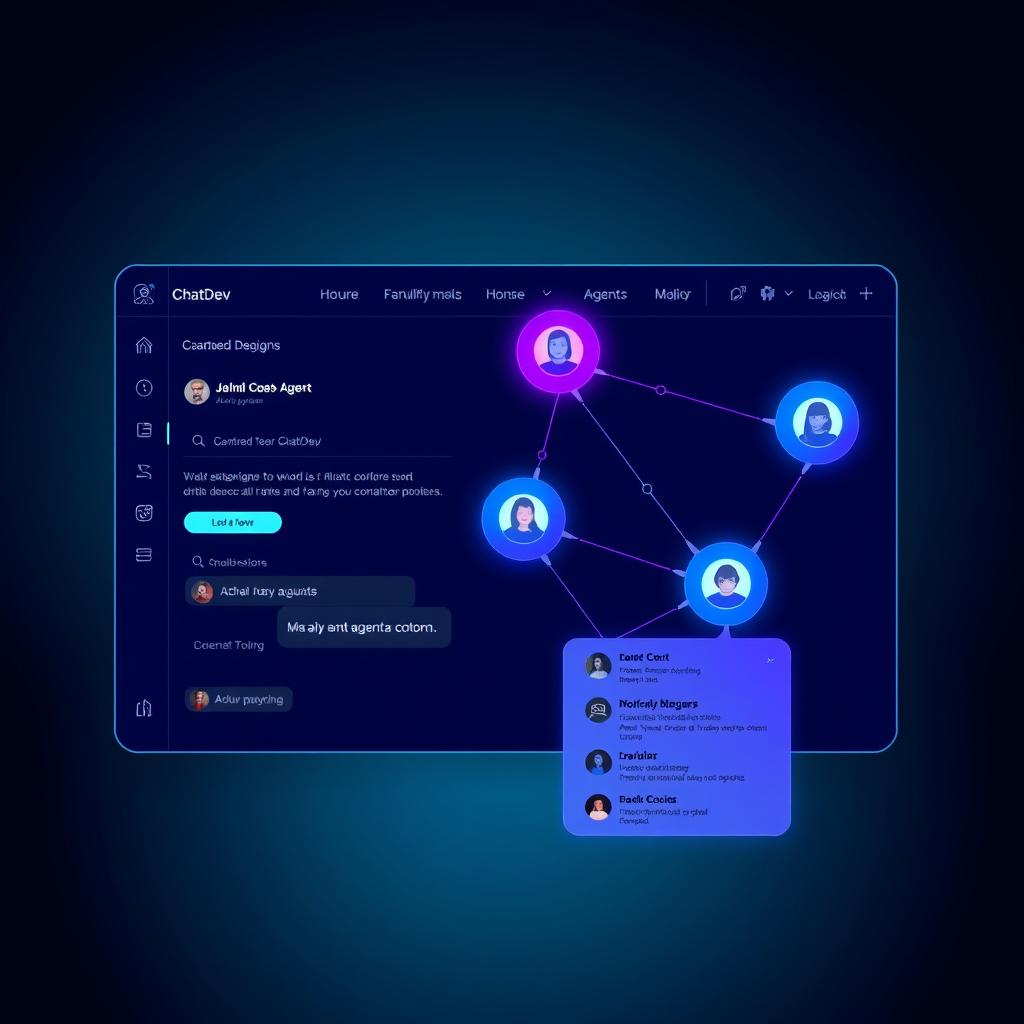
ChatDev Review 2026: OpenBMB's 33K★ Zero-Code Multi-Agent Platform That Democratizes AI Orchestration
📖 What Is ChatDev?
ChatDev is an open-source multi-agent orchestration platform developed by OpenBMB — the same team behind PilotDeck and MiniCPM. Starting as a research project at Tsinghua University's NLP lab, ChatDev has evolved from a Virtual Software Company simulation into a full-fledged zero-code platform for designing and running multi-agent AI workflows. With 33,400+ GitHub stars, 4,200+ forks, and its paper accepted to ACL 2024, it's one of the most influential open-source projects in the multi-agent space [1].
The original ChatDev (v1.0) simulated a software company where agents played roles like CEO, CTO, and Programmer to automate the software development lifecycle. In January 2026, OpenBMB released ChatDev 2.0 (DevAll) — a complete rewrite that transforms the platform into a general-purpose, zero-code multi-agent orchestration tool. The name "DevAll" reflects the expanded scope: develop everything, not just software [2].
Built on a FastAPI backend with a Vue 3 frontend, ChatDev uses a MacNet (Modular Agent Collaboration Network) architecture with Directed Acyclic Graph (DAG) support to define agent workflows. Workflows are configured via YAML files or the visual drag-and-drop designer, with a Python SDK for programmatic control. The platform supports any LLM that exposes an OpenAI-compatible API, giving users flexibility to choose the best model for each task [1].
What sets ChatDev apart from every other multi-agent framework is its mission: make multi-agent orchestration accessible to non-developers. While LangGraph, CrewAI, and AutoGPT all require Python code, ChatDev lets you design complex agent collaboration pipelines purely through a visual interface — no code required.
📊 At a Glance & ✅ Pros & Cons
| Feature | ChatDev 2.0 (DevAll) | CrewAI | LangGraph | AutoGPT |
|---|---|---|---|---|
| Category | Multi-Agent Platform | Multi-Agent Framework | Multi-Agent Framework | Autonomous Agent |
| Pricing | Free | Free (MIT) | Free (MIT) + Platform $39/mo | Free |
| License | Apache 2.0 | MIT | MIT | MIT |
| UI Design | ✅ Visual drag-and-drop | ❌ Code only | ❌ Code only | ❌ Code + CLI |
| GitHub Stars | 33.4K | 48K | 22K | 184K |
| Architecture | DAG (MacNet) | Role-based Crews | Stateful Graphs | Autonomous loop |
| Multi-LLM | ✅ Per-agent | ✅ Per-agent | ✅ Per-node | Single |
| Agent Memory | ✅ IER (evolving) | ✅ Basic | ✅ State persistence | ✅ Vector memory |
| SDK Languages | Python | Python | Python, TypeScript | Python |
| Non-devs | ✅ Yes (visual) | ❌ No | ❌ No | ❌ No |
✅ What It Does Best
- Zero-code visual design — Drag-and-drop workflow builder makes multi-agent AI accessible to domain experts, PMs, and non-engineers who can't write Python
- MacNet DAG architecture — Directed acyclic graphs prevent infinite loops and support 1000+ agents without context window exhaustion
- Iterative Experience Refinement — Agents learn from past runs and improve collaboration over time; no other open-source framework does this
- Multi-domain templates — Pre-built workflows for research, data viz, 3D, content creation, and software development speed up onboarding
- Fully free and open-source — Apache 2.0 with no paid tiers, no feature gating, no hidden enterprise upsells
❌ Where It Falls Short
- Visual design isn't code-reviewable — YAML-defined workflows can't be diffed, reviewed in PRs, or version-controlled with the same rigor as code
- Enterprise scalability unproven — No published benchmarks for high-throughput production loads or workflows with hundreds of agents
- Shallow Python SDK — Programmatic control doesn't match the depth of LangGraph's graph API or CrewAI's role configuration system
- Python-only SDK — No TypeScript, Go, Rust, or Java bindings limit integration options for non-Python teams
- CLI/CI limitations — Heavy reliance on the Vue 3 UI makes automation via scripts or CI/CD pipelines harder than text-based frameworks
Python-based multi-agent orchestration framework with role-based Crews. The most popular alternative for developers needing code-defined agent workflows.
OpenAI Agents SDKOpenAI's open-source multi-agent framework with sandbox execution, handoffs, and guardrails. Strongest for teams already in the OpenAI ecosystem.
AutoGPTThe 184K-star autonomous agent framework. Best for single-agent, long-running autonomous task completion compared to ChatDev's multi-agent orchestration.
Graph-based agent framework from LangChain. Stateful, durable execution with human-in-the-loop. Stronger for production deployments requiring code review.
OpenBMB's task-oriented AI agent productivity platform. Sibling project to ChatDev, focused on individual task execution rather than multi-agent workflows.
✨ Capabilities & Agentic Deep Dive
Visual Workflow Designer
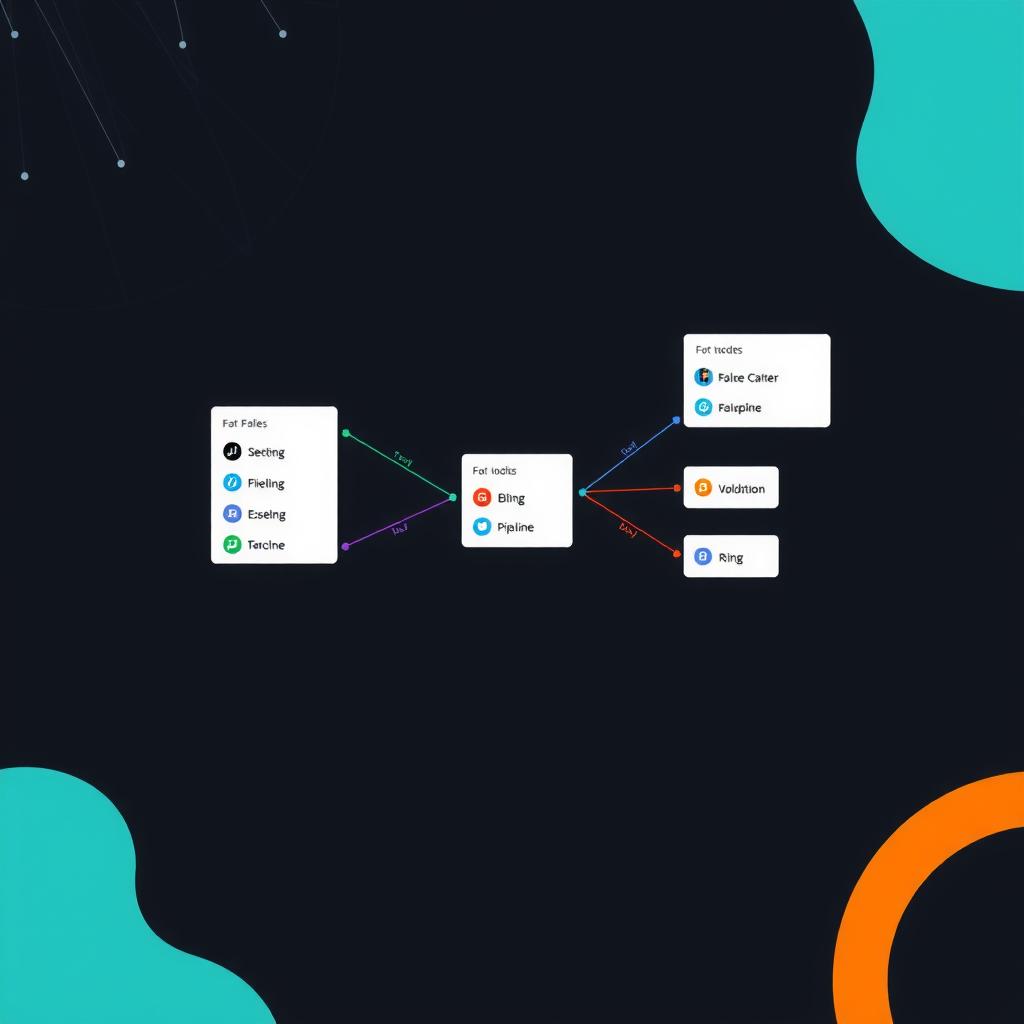
ChatDev's flagship feature is its drag-and-drop workflow designer, built with Vue 3. You create agents as boxes on a canvas, connect them with directional edges, and configure each agent's role, LLM, system prompt, and tools through a visual inspector panel. The interface is reminiscent of Zapier or n8n, but purpose-built for AI agent orchestration. Each agent node can be assigned a different LLM backend — so you could have a research agent using Claude Opus for synthesis, a data extraction agent using GPT-4.1 for structured output, and a writing agent using Gemini 3 Flash for creative generation, all in the same workflow [3].
MacNet DAG Architecture
Introduced in June 2024, MacNet (Multi-Agent Collaboration Networks) is ChatDev's architectural foundation. It uses a Directed Acyclic Graph model where each agent is a node and edges represent one-way data flow. The DAG constraint prevents circular dependencies and infinite loops — a common failure mode in multi-agent systems. MacNet supports over 1000 agents in a single workflow without context window limits by splitting communication into modular sub-graphs. Each sub-graph operates within its own context window, with only summarized outputs passed between sub-graphs [4].
Iterative Experience Refinement (IER)
IER is ChatDev's most advanced feature and a genuine differentiator in the multi-agent space. When agents execute a workflow, they record what worked, what failed, and how they adapted. On subsequent runs, agents retrieve relevant past experiences and adjust their collaboration strategy. This means a research pipeline that failed to find relevant sources on the first run will try different search strategies on the second. Over time, agent teams develop "institutional memory" that improves reliability without human intervention. IER was introduced in a May 2024 paper and is deeply integrated into ChatDev 2.0's runtime [5].
Multi-Domain Template Library
ChatDev ships with a growing library of pre-built workflow templates organized by domain. The data visualization templates create 4-6 high-quality PNG charts from datasets. The 3D generation templates integrate with Blender via MCP to produce 3D assets. The research pipeline templates implement gather-analyze-write chains with citation management. The content creation templates handle the full workflow from topic research through draft generation to publication. Each template is a YAML file in the yaml_instance/ directory that users can customize through the UI or directly edit [1].
YAML-Based Workflow Configuration
Every ChatDev workflow is defined as a YAML file — a human-readable format that's more accessible than Python code while still being version-controllable. Environment variables can be injected via ${VAR} placeholders, keeping API keys out of workflow definitions. Users can switch between the visual designer and raw YAML editing, with changes synced in real-time. The validation command (make validate-yamls) checks all workflow files for correctness before deployment [1].
OpenClaw Integration
ChatDev 2.0 integrates natively with the OpenClaw agent ecosystem. You can install ChatDev skills via clawdhub install chatdev and then trigger workflows from within OpenClaw. Example prompts include "Create a ChatDev workflow to automatically collect trending information, generate a social media post, and publish it" — bridging the gap between local agent execution and multi-agent orchestration [1].
🔬 AI Performance Analysis
🦾 Ease of Use
ChatDev 2.0 is the most accessible multi-agent platform for non-developers on the market. The visual workflow designer requires zero coding — you drag agents onto a canvas, configure their roles through form fields, connect them with directional arrows, and hit run. The installation is straightforward: clone the repo, run uv sync for the backend and npm install in the frontend directory, then make dev to launch both. Docker Compose is available for users who prefer containerized deployment. The learning curve for developers is measured in minutes; for non-developers, the visual interface makes multi-agent concepts concrete and approachable. The only friction is that switching between the UI and YAML editing can be jarring for those who prefer text-based configuration.
⚙️ Features
ChatDev packs an impressive feature set for an open-source project. The visual workflow designer, MacNet DAG architecture, IER, multi-domain templates, YAML configuration, environment variable injection, Docker support, OpenClaw integration, and Python SDK cover most use cases. The platform supports any OpenAI-compatible LLM, per-agent model assignment, file attachments, and custom tool functions. The make validate-yamls command is a nice quality-of-life addition for catching configuration errors before runtime. What's missing: no TypeScript or Go SDK, no built-in monitoring or observability, no A/B testing for workflow variants, and no visual debugging mode (stepping through agent execution). Most of these are available in the SaaS version at chatdev.modelbest.cn but not in the open-source build [2].
🚀 Performance
ChatDev performs well for typical multi-agent workloads — research pipelines, content generation, data analysis, and software prototyping. The FastAPI backend handles concurrent workflow executions efficiently, and the MacNet DAG architecture prevents the catastrophic failures (infinite loops, context overflow) that plague cyclic multi-agent systems. For workflows with 3-10 agents, execution is snappy and reliable. However, enterprise-scale performance is unverified: there are no published benchmarks for workflows with dozens of agents, high concurrent load, or long-running autonomous operations. The IER system adds memory overhead on each run, which accumulates over time. The platform's reliance on the LLM's API latency means performance is tied to your chosen model provider. For teams comparing against CrewAI or LangGraph, ChatDev is competitive at small-to-medium scale but enters uncharacterized territory at production loads [6].
📚 Documentation
ChatDev's documentation has improved significantly with the 2.0 release. The GitHub README is comprehensive, covering installation (bare-metal, uv, Docker), configuration, YAML schema, the Python SDK, frontend setup, and troubleshooting. The docs include a getting-started guide, workflow authoring documentation, module references for memory and tooling, and YAML validation instructions. The paper (arXiv:2307.07924, accepted to ACL 2024) provides deep technical background on the chat chain and communicative dehallucination mechanisms. Screenshots of the UI help non-developers visualize the workflow. What's lacking: video tutorials, interactive examples, a searchable knowledge base, and production deployment guides for scaling beyond single-server setups. The documentation assumes users are comfortable with the terminal, which is reasonable for an open-source tool but creates friction for the non-developer audience ChatDev claims to target [1][7].
🎯 Support
As an open-source project under the OpenBMB organization at Tsinghua University, ChatDev's support model is community-driven. The GitHub repository has an active issue tracker with responsive maintainers — the project sees regular commits and the 2.0 launch in January 2026 was well-communicated. The research paper has been cited extensively (the ACL 2024 publication gives it academic credibility), and the project has spawned discussions across Reddit, Hacker News, and AI community forums. However, there's no dedicated Discord server, no official forum, no paid support tier, and no SLAs. OpenBMB's other projects (PilotDeck, MiniCPM) share the same support model — active during business hours, no guaranteed response times. For hobbyists and researchers, this is sufficient. For enterprise teams requiring commercial support, ChatDev currently offers no path beyond filing GitHub issues and hoping for a response [1].
🎯 Ideal Use Cases
✅ Best For
|
❌ Not Ideal For
|
ChatDev is fully free and open-source. No paid tiers, no feature gates, no enterprise upsells. Self-host with Docker or uv. SaaS version available at chatdev.modelbest.cn for users who prefer a hosted experience.
Quick start: git clone https://github.com/OpenBMB/ChatDev && cd ChatDev && make dev — then open http://localhost:5173 and start designing workflows visually.
| ❓ FAQ | |
|---|---|
| What is ChatDev and how is it different from other multi-agent frameworks? | ChatDev is a zero-code multi-agent orchestration platform by OpenBMB. Unlike CrewAI or LangGraph which require Python code to define agents and workflows, ChatDev lets you design multi-agent systems through a visual drag-and-drop interface. Its MacNet architecture supports DAG-based workflows with over 1000 agents, and its Iterative Experience Refinement lets agents learn from past runs — a unique feature in the multi-agent space. |
| Is ChatDev really free? | Yes. ChatDev is fully open-source under the Apache 2.0 license. The entire platform — visual workflow designer, Python SDK, all agent templates, and the MacNet orchestration engine — is free to use, modify, and deploy. There's no paid tier for the open-source version. A SaaS platform is available at chatdev.modelbest.cn for users who prefer a hosted solution. |
| What kind of workflows can I build with ChatDev? | ChatDev supports research pipelines (gather → analyze → write), data visualization (query → chart → present), 3D generation (with Blender integration), content creation (research → draft → edit → publish), social media automation, software development (plan → code → test → document), and custom agent chains. The template library provides pre-built starting points for most common patterns. |
| How does ChatDev 2.0 compare to ChatDev 1.0? | ChatDev 1.0 was a Virtual Software Company pattern — CEO, CTO, Programmer agents collaborating on software development. ChatDev 2.0 (DevAll) is a complete rewrite: a zero-code platform that supports any domain, not just software development. It adds the visual workflow designer, MacNet DAG architecture, YAML-based configuration, Python SDK, and a Vue 3 frontend. v1.0 is maintained on the chatdev1.0 branch. |
| What LLMs does ChatDev support? | ChatDev is LLM-agnostic. You configure the API endpoint and key via environment variables. It works with OpenAI, Anthropic, Google Gemini, open-source models via Ollama, or any OpenAI-compatible API. Each agent in a workflow can be assigned a different LLM, allowing you to route specific tasks to the best model for that job. |
| 📖 Related Reads | |
|---|---|
| CrewAI Review 2026 | Multi-agent orchestration framework used by 63% of the Fortune 500. Role-based Crews vs ChatDev's visual DAG approach. |
| OpenAI Agents SDK Review 2026 | OpenAI's open-source multi-agent framework with sandbox execution — the closest competitor from the ML giant. |
| LangGraph Review 2026 | Graph-based agent framework from LangChain. Stronger for production systems requiring code-defined graphs. |
| AutoGPT Review 2026 | The 184K-star autonomous agent framework. Different paradigm — single complex agents vs ChatDev's multi-agent collaboration. |
| 📚 Verification & Citations | |
|---|---|
| https://github.com/OpenBMB/ChatDev | Official GitHub Repository — 33.4K stars, Apache 2.0, ChatDev 2.0 (DevAll) release notes. Accessed June 2026. |
| https://arxiv.org/abs/2307.07924 | ChatDev: Communicative Agents for Software Development — ACL 2024 paper describing chat chain and communicative dehallucination. Accessed June 2026. |
| https://yuv.ai/blog/chatdev-devall | YUV.AI — ChatDev 2.0 deep dive with feature analysis, architecture diagrams, and code examples. Accessed June 2026. |
| https://arxiv.org/abs/2406.07155 | MacNet: Multi-Agent Collaboration Networks — DAG-based architecture supporting 1000+ agents without context limits. Accessed June 2026. |
| https://arxiv.org/abs/2405.04219 | Iterative Experience Refinement (IER) — Agents learn from past executions and improve collaboration over time. Accessed June 2026. |
| https://github.com/OpenBMB/ChatDev/releases | ChatDev Releases — Version history, changelog, and milestone tracking. Accessed June 2026. |
| https://github.com/OpenBMB/ChatDev/blob/main/README.md | Official documentation — Setup, configuration, YAML schema, Python SDK, and troubleshooting. Accessed June 2026. |
| https://arxiv.org/abs/2312.17025 | Experiential Co-Learning — Shortcut-oriented experience accumulation for multi-agent systems. Accessed June 2026. |
OpenBMB releases ChatDev 2.0, a complete rewrite of the multi-agent platform. Zero-code visual workflow designer, MacNet DAG architecture, Iterative Experience Refinement, and multi-domain template library mark the biggest update since the project's inception.
The paper "Multi-Agent Collaboration via Evolving Orchestration" is accepted to NeurIPS 2025, introducing a learnable central orchestrator optimized via reinforcement learning.
Multi-Agent Collaboration Networks (MacNet) paper released. DAG-based architecture supporting 1000+ agents without context window limits — foundational to ChatDev 2.0.
- June 9, 2026: Full review published — hands-on with ChatDev 2.0 (DevAll), MacNet DAG architecture, IER, and visual workflow designer. Score: 7.8/10.
- January 7, 2026: ChatDev 2.0 (DevAll) officially released — zero-code multi-agent platform.
- September 24, 2025: NeurIPS 2025 paper accepted for evolving orchestration.
- June 12, 2024: MacNet architecture paper published — DAG-based multi-agent collaboration.
- July 16, 2023: Original ChatDev paper submitted to arXiv (ACL 2024).
📖 Related Reads
- NiteAgent — AI agent development, frameworks, and production patterns
- ToolBrain — tool reviews, LLM comparisons, and AI workflow guides
- NoCode Insider — AI workflow automation with no-code tools, agents, and APIs
- CodeIntel Log — code quality, debugging, and software engineering benchmarks
- Hermes Tutorials — Hermes Agent setup, configuration, and advanced workflows
Cross-links automatically generated from None.
Back to all posts