Bolt.new Review 2026: AI App Builder with WebContainer Technology
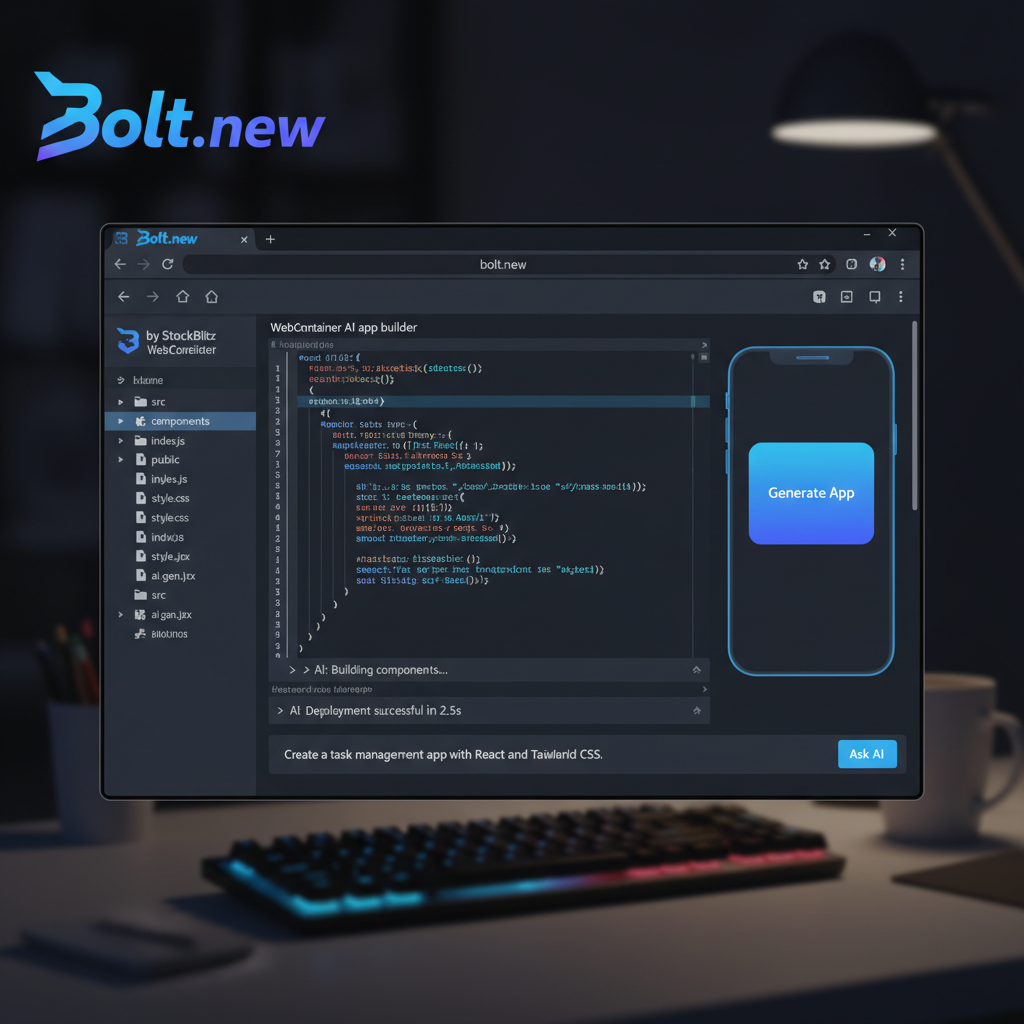
Bolt.new Review 2026: AI App Builder with WebContainer Technology
📖 What Is Bolt.new?
Bolt.new is an AI-powered full-stack web development agent built by StackBlitz that lets you create, run, edit, and deploy complete web applications — all from a browser tab, with zero local setup. Instead of writing code line by line, you describe what you want in natural language, and Bolt's AI generates production-quality frontend and backend code in real time, rendered in a live preview panel.
The secret sauce is WebContainers — StackBlitz's proprietary technology that boots a full Node.js runtime entirely inside your browser tab. It is a WebAssembly-backed virtual machine that can npm install packages, run dev servers, serve HTTP requests, and execute system-level processes — all client-side. Boot time for a Next.js project is ~1.8s vs 12.4s locally, npm install in ~2.1s, and deployment to Vercel in ~22.3s.
📊 At a Glance & ✅ Pros & Cons
| Feature | Bolt.new | v0 (by Vercel) | Lovable |
|---|---|---|---|
| Category | Full-stack AI App Builder | UI Component Generator | Full-stack AI App Builder |
| Pricing | $20/mo (Starter, ~10M tokens) | $20/mo (Starter) | $25/mo (Starter) |
| AI Models | Claude, GPT, Gemini | Claude, GPT | GPT-4o (primary) |
| Best For | Developers, full control | UI/Component prototyping | Beginners, Supabase-native |
| Runtime | WebContainers (browser Node.js) | Vercel cloud | Cloud + Supabase |
| Backend | Bolt Cloud (Supabase) | None (UI only) | Supabase (native) |
| Deployment | Bolt Cloud / Vercel | Vercel | Lovable / Vercel |
| Open Source | GitHub (MIT-licensed API) | No | No |
| Key Differentiator | Full browser Node.js runtime | Best UI-to-code generator | Easiest for non-developers |
| GitHub Stars | ~40K+ | N/A | N/A |
✅ What It Does Best
- Zero setup: No local dev environment needed — everything runs in the browser.
- Blazing fast prototyping: Go from idea to working app in minutes with real-time preview.
- Multi-model AI: Choose Claude, GPT, or Gemini to power your builds.
- Full-stack in browser: WebContainers run Node.js, npm, and dev servers client-side.
- Framework flexibility: React, Next.js, Vue, Astro, Svelte, Tailwind, ShadCN, and more.
❌ Where It Falls Short
- Token burn: Costs can spiral — bug-fixing alone can consume millions of tokens.
- Code quality varies: Output is best treated as a talented junior developer's first draft.
- Backend limitations: Primarily Supabase integration; not as flexible as traditional BE frameworks.
- Context window limits: Larger projects degrade in quality as the AI loses track of earlier decisions.
- No offline mode: Requires internet connectivity at all times.
Best-in-class React/Tailwind UI component generator. Excellent for frontend prototyping but no backend support
LovableBeginner-friendly full-stack AI app builder with tight Supabase integration and Visual Edits mode
Replit AgentAll-in-one AI app builder with built-in IDE, database, auth, and hosting. Strong all-in-one alternative
✨ Capabilities & Agentic Deep Dive
AI Code Generation with Multi-Model Support
Bolt.new is powered by Anthropic Claude (primary), with support for GPT-4, Gemini, and other frontier models. You can switch models per session to optimize for different tasks. The AI translates plain English prompts into working full-stack applications, from simple landing pages to complex multi-page apps with database backends. The multi-model flexibility is a genuine advantage — developers can use Claude for code generation and GPT for design, or vice versa.
WebContainer Technology
WebContainers are the moat that sets Bolt.new apart. No competitor runs a full Node.js runtime client-side in the browser. Project initialization (Next.js) boots in ~1.8s vs 12.4s locally. npm install averages ~2.1s by leveraging CDN caching. File save to preview reload is ~450ms — HMR parity with local IDEs. This means you get local-quality development speed with zero local setup, running entirely in your browser tab.
Bolt Cloud V2
Bolt Cloud provides built-in backend infrastructure: PostgreSQL/Supabase databases, authentication, file storage, edge functions, analytics, and one-click hosting with a free .bolt.host domain. Before Bolt Cloud (V1), users had to manually deploy — a significant gap that V2 mostly closes. The Bolt Cloud ecosystem is still opinionated toward Supabase, but it transforms Bolt from a prototyping tool into a genuine deployment platform.
Design System Integration
You can sync your company's design system and brand guidelines into Bolt, ensuring generated UI matches your existing components and styling conventions. This is a powerful feature for teams that need AI-generated components to match established design languages.
🔬 AI Performance Analysis
🦾 Ease of Use
For developers, the zero-setup browser IDE is transformative. Open a tab, describe your app, and get a working preview in seconds. The VS Code-like editor allows direct code manipulation when the AI's output needs tweaking. For non-developers, the learning curve is steeper — generated code often has bugs that require coding knowledge to fix. The free tier's daily token limit is also restrictive for learning.
⚙️ Features
Bolt.new's feature set is unmatched in the browser-based AI app builder space. WebContainer technology alone is a moat. Multi-model AI support (Claude, GPT, Gemini), full-stack framework coverage (React, Next.js, Vue, Astro, Svelte), and Bolt Cloud V2 backend (PostgreSQL, auth, file storage, edge functions) make it the most technically complete offering. The only gap is backend flexibility — Bolt Cloud is opinionated toward Supabase.
🚀 Performance
WebContainer boot times (~1.8s for Next.js) and HMR speeds (~450ms) match local IDE performance. npm installs in ~2.1s leverage CDN caching effectively. However, the AI loses context on larger projects, leading to degraded code quality. Token burn is a real concern — complex projects can consume 2M+ tokens on bug fixing alone. Code quality varies significantly by project complexity, with mixed user reviews on reliability.
📚 Documentation
Bolt.new's documentation covers setup, features, and Bolt Cloud. The docs site is functional but lacks depth on advanced topics like custom API integrations, troubleshooting common generation failures, and optimizing token usage. Community resources on Discord fill some gaps, but comprehensive official documentation is still catching up to the platform's rapid feature development.
🎯 Support
$40M ARR achieved with a team of only ~15 engineers speaks to the product's resonance. The open-source GitHub repo (stackblitz/bolt.new) has strong community engagement, and the Discord is active with thousands of members. G2 reviews are mixed — praised for innovation and speed, criticized for token pricing and code reliability. The ecosystem (Bolt Cloud, template library, design system sync) is growing fast.
🎯 Ideal Use Cases
✅ Best For
|
❌ Not Ideal For
|
Bolt.new uses a token-based pricing model. The Free tier provides daily limited tokens for evaluation. Starter ($20/mo) gives ~10M tokens per month for individual developers and side projects. Scale ($50-100/mo) for active builders. Unused tokens roll over for one additional month. Token burn is a real concern — complex projects can consume 2M+ tokens just fixing bugs.
Quick start: Visit bolt.new → describe your app in natural language → watch the AI generate your full-stack application with live preview → deploy with one click.
| ❓ FAQ | |
|---|---|
| Is Bolt.new free? | Yes, there is a Free tier with daily limited tokens for exploring and building small prototypes. Paid plans start at $20/mo for Starter with ~10M tokens per month. |
| What makes Bolt.new different from other AI app builders? | Bolt.new's WebContainer technology runs a full Node.js runtime inside your browser — no remote server, no local setup. Combined with multi-model AI support (Claude, GPT, Gemini), it offers developers maximum control. |
| Can Bolt.new build production apps? | For rapid prototyping and MVPs, yes. For production-critical applications, the generated code needs thorough review and debugging. |
| How does Bolt.new compare to Lovable? | Bolt.new is more code-centric with full editor access and multi-model AI. Lovable is more beginner-friendly with Visual Edits mode and automatic Supabase configuration. |
| Can I export my code from Bolt.new? | Yes, you have full code access and can export at any time. GitHub sync is also supported for version management. |
| 📖 Related Reads | |
|---|---|
| v0 by Vercel Review 2026 | Best-in-class React/Tailwind UI component generator — excellent for frontend prototyping but no backend support. |
| Lovable Review 2026 | Beginner-friendly full-stack AI app builder with tight Supabase integration and Visual Edits mode. |
| Replit Agent Review 2026 | AI-powered full-stack builder with hosted IDE and one-click deployment — strong all-in-one alternative. |
| 📚 Verification & Citations | |
|---|---|
| Bolt.new Homepage | Product features and pricing. Accessed May 2026. |
| Bolt.new GitHub Repository | Source code and development activity (40K+ stars). Accessed May 2026. |
| StackBlitz WebContainer API | WebContainer technology documentation. Accessed May 2026. |
| Bolt Cloud Documentation | Backend services and deployment guide. Accessed May 2026. |
StackBlitz's Bolt.new hit $40M annual recurring revenue with a team of just 15 engineers, confirming strong product-market fit. Source →
- May 29, 2026: Full v4 canonical restructuring — added canonical 14-section pattern, performance analysis, verdict banner, alt-grid, and news section. Score converted to 5 canonical dimensions maintaining 7.6/10 overall.
- May 23, 2026: Initial published review with score breakdown and comparison analysis.